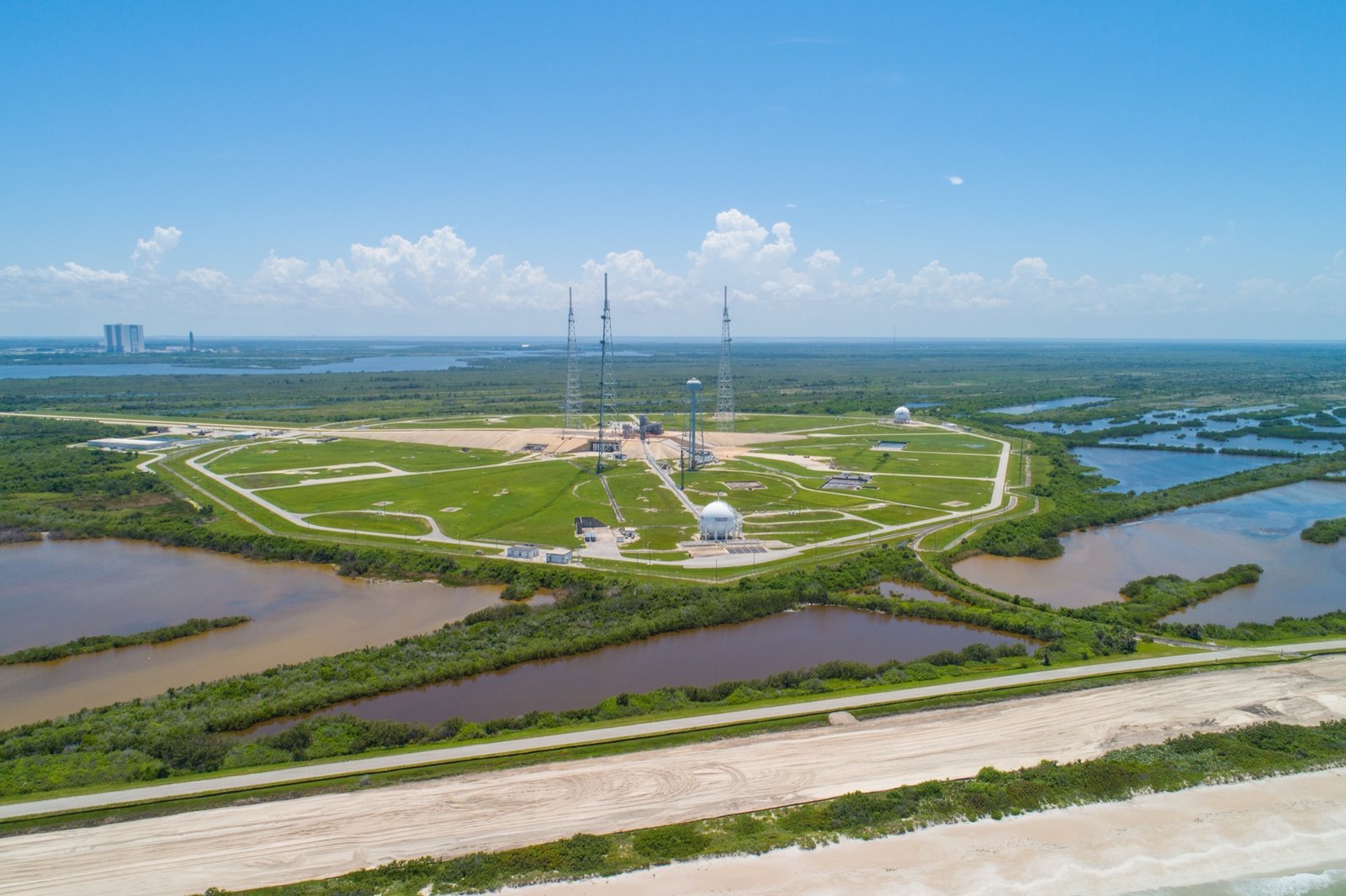
One Failed Constraint Can Kill a Spaceport Site, Here's What to Check First
Developing spaceports, rocket engine test stands, and defense manufacturing facilities requires balancing statutory safety buffers, environmental protections, and extreme structural demands, often on land where no comparable facility has ever been built before.
From orbital vertical launch complexes to high-thrust test facilities, site selection must satisfy complex airspace, acoustic, and explosive hazard regulations before breaking ground. Unlike most commercial or industrial real estate, a single failed constraint here does not just raise costs, it can disqualify a site outright.
Siting Challenges in Space and Defense
1. Statutory Blast Safety Setbacks. Propellant storage and rocket engine testing fall under strict explosive hazard regulations, such as UN Class 1.1. Establishing required Hazard Inhabited Building Distance (HIBD) envelopes demands vast, contiguous land areas clear of third-party structures, which in practice rules out the great majority of otherwise well-connected sites before any other criterion is applied.
2. Acoustic Contours and Structural Integrity. Rocket engine ignitions create extreme low-frequency sound waves. Facilities require multi-kilometer acoustic buffer zones to mitigate noise impacts on neighboring areas. Simultaneously, launch mounts require exceptional bedrock stability to withstand high dynamic loads, meaning a site can satisfy every regulatory buffer and still fail on geotechnical grounds alone.
3. Heavy Freight and Airspace Logistics. Space and defense facilities require specialized heavy-axle freight routes to transport large rocket stages or defense assemblies, alongside unhindered downrange launch corridors over open water or unpopulated terrain. A site can clear every ground-level constraint and still be unworkable if the airspace above it, or the route to it, cannot support the mission.
Why Traditional Site Studies Fall Short
Conventional site selection processes evaluate these constraints sequentially, often across separate specialist consultants for acoustics, blast modeling, geotechnical survey, and logistics. For a facility category where a single failed constraint can disqualify a site entirely, sequential evaluation is not just slow, it risks committing capital and exclusivity to a site long before the disqualifying factor is discovered.
Precision Site Screening with PropVeritas
Selecting land for high-hazard aerospace and defense assets requires absolute data rigor and transparent due diligence.
Siting Intelligence with PropVeritas
PropVeritas equips defense contractors, spaceport operators, and institutional land funds with specialized spatial intelligence:
- Model Blast and Safety Setbacks: evaluate candidate sites against custom blast exclusion radii and environmental protection zones.
- Subsurface Stability and InSAR Analysis: screen candidate pads for ground movement using satellite-based synthetic aperture radar (SAR) and high-resolution DTMs.
- Instant Feasibility Synthesis: combine bare-earth slope analysis, logistics connectivity, and hazard constraints into a single executive briefing.
For a facility category where the cost of a wrong site is measured in years and in program risk, not just capital, evidence-based screening at the earliest stage is not a convenience. It is the difference between a program that holds its schedule and one that does not.
Explore how PropVeritas streamlines specialized site selection. Contact our engineering team for a private demo.
Related Articles
PropVeritas fuses satellite Earth Observation, LiDAR terrain models, and government registries into a single site intelligence layer, screening grid, freight, hazard, and geotechnical constraints together instead of one specialist study at a time.
If site selection is the bottleneck on your next industrial or infrastructure program, we would welcome the conversation.